
Quick answer: The fertile window is the short stretch of days in each menstrual cycle when having sex can lead to pregnancy. It lasts about 6 days — the 5 days before ovulation plus the day of ovulation itself. This is called the “6-day rule.” It exists because sperm can survive up to 5 days inside the body, while the egg only lives for about 12–24 hours after release. Your most fertile days are the 2–3 days right before ovulation and ovulation day.
That’s the summary. Below is the full picture of the science behind the 6-day rule, when your window actually falls, and how to pinpoint it accurately.
What is the fertile window?
The fertile window is the group of days in your menstrual cycle when conception is biologically possible. Outside this window, the chance of getting pregnant from a single act of intercourse is effectively zero, because either the egg hasn’t been released yet in a way sperm can reach, or the egg has already died.
Even though a cycle is around 28 days long on average, you are only fertile for roughly 6 of those days. Understanding which 6 days matters whether you’re trying to conceive or trying to understand your body better.
The window is defined by two biological facts working together:
- Sperm can survive up to 5 days in fertile cervical mucus inside the reproductive tract.
- The egg survives only about 12–24 hours after ovulation.
Put those together and you get a window that opens up to 5 days before ovulation and closes about a day after it, roughly 6 days total.
What is the 6-day rule?
The “6-day rule” is the well-established finding that pregnancy almost only occurs when intercourse happens during a six-day interval ending on the day of ovulation.
This comes from landmark research on couples trying to conceive, which tracked the exact timing of intercourse relative to ovulation. The key finding was clear: conception happened only when sex occurred somewhere in the window from 5 days before ovulation up to and including ovulation day. Intercourse earlier than 5 days before, or after the day following ovulation, did not result in pregnancy in that data.
In plain terms:
If ovulation is “Day 0,” your fertile window runs from Day −5 to Day 0 — six days.
This is why timing is everything when you’re trying to conceive, and why “just have sex around the middle of the month” is imprecise advice.
Why is the fertile window exactly 6 days?

The 6-day length isn’t arbitrary — it’s the sum of two survival timelines.
Sperm lifespan (up to ~5 days): In the presence of fertile-quality cervical mucus (clear, stretchy, and slippery), sperm can live in the reproductive tract for several days, commonly cited as up to 5 days. This means sperm from sex on Monday can still be waiting to fertilize an egg released on Friday.
Egg lifespan (~12–24 hours): Once ovulation releases the egg, it must be fertilized within roughly 12 to 24 hours or it disintegrates. This is a hard, short deadline — which is why the window closes quickly after ovulation.
Because sperm arrive early and wait, most of the fertile window is actually before ovulation, not after it.
When does the fertile window happen in your cycle?

Here’s the most misunderstood part: ovulation does not always happen on Day 14.
The common “Day 14” figure only applies to a textbook 28-day cycle. What’s actually more stable is the luteal phase — the time from ovulation to your next period — which lasts about 12–14 days for most people. So a more reliable way to estimate ovulation is to count backward from your next expected period, not forward from your last one.
A simple estimate: ovulation ≈ next period start date minus 14 days.
| Cycle length | Approx. ovulation day | Approx. fertile window (cycle days) |
|---|---|---|
| 24 days | Day 10 | Days 5–10 |
| 28 days | Day 14 | Days 9–14 |
| 30 days | Day 16 | Days 11–16 |
| 32 days | Day 18 | Days 13–18 |
(Day 1 = the first day of your period.) These are estimates. Your real window can shift from cycle to cycle, so tracking signs (below) beats relying on the calendar alone.
Which days are the most fertile?
Not all 6 days are equal. The probability of conception rises as you approach ovulation and peaks just before it.
- Highest fertility: the 2–3 days before ovulation and ovulation day itself.
- Moderate fertility: 4–5 days before ovulation.
- Lowest (within the window): the day after ovulation, as the egg is nearing the end of its lifespan.
The single most fertile day is often the day before ovulation, when fresh cervical mucus is helping sperm survive and an egg is about to be released. So couples trying to conceive often aim for sex every 1–2 days across the fertile window, rather than trying to hit one perfect day.
How to find your fertile window

There are five practical ways to identify your window. Combining two or more gives the most accurate result.
1. Cervical mucus method
As you approach ovulation, cervical mucus changes from dry or sticky to clear, stretchy, and slippery — like raw egg white. This “egg-white cervical mucus” is your body’s strongest natural fertility signal and usually appears in the days right before ovulation. When you see it, you’re in your fertile window.
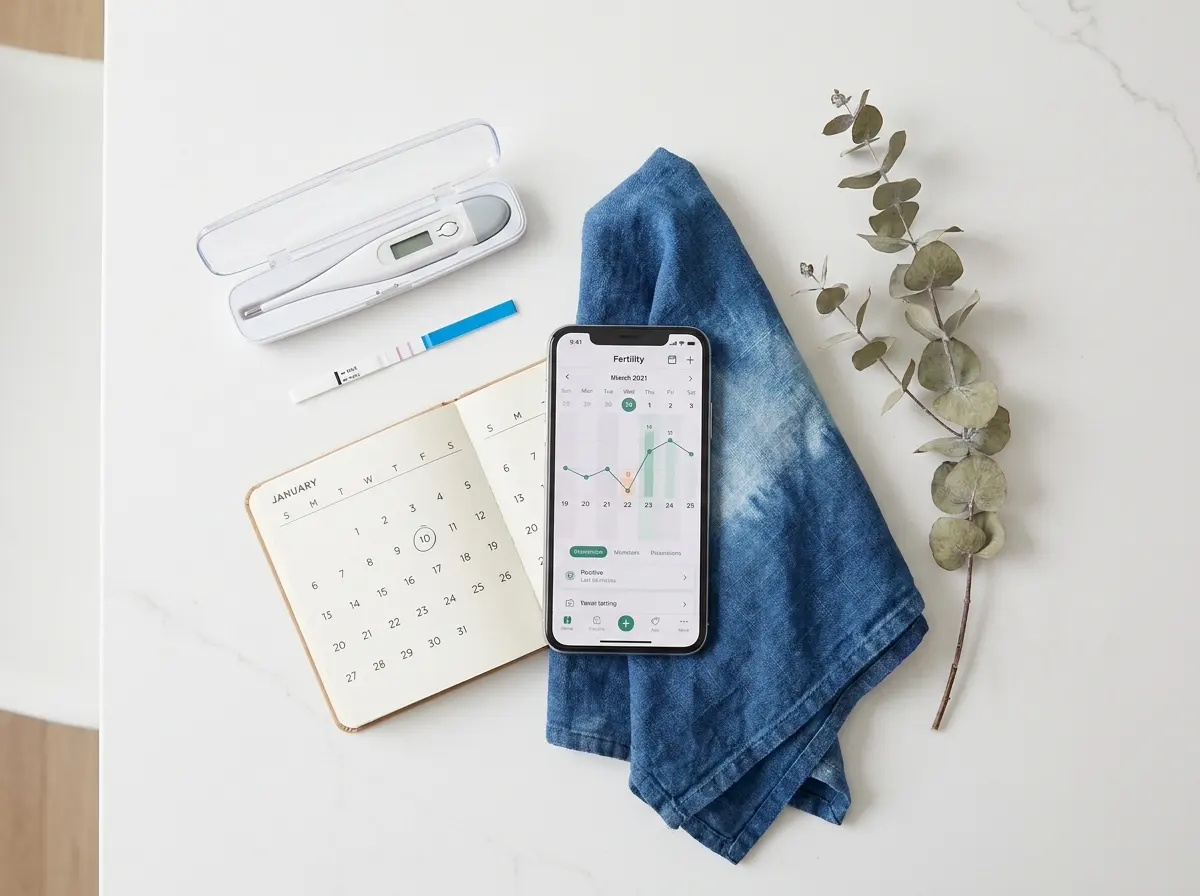
2. Ovulation predictor kits (OPKs)
These urine strips detect the LH surge — a spike in luteinizing hormone that triggers ovulation. A positive OPK means ovulation is likely to happen in the next 24–36 hours, so the day of a positive test and the next day are prime time.
3. Basal body temperature (BBT)
Your resting body temperature rises slightly (about 0.3–0.5°C) after ovulation, due to progesterone. Important nuance: BBT confirms ovulation has already happened — it doesn’t predict it in advance. It’s excellent for learning your pattern over a few cycles, but not for catching this cycle’s window in real time on its own.
4. Cycle tracking / calendar method
If your cycles are regular, you can estimate your window from past cycle lengths (using the “next period minus 14” logic above). Simple, but least accurate — especially if your cycles vary.
5. Fertility apps
Apps combine your logged period dates, and often BBT and OPK results, to predict your window. They’re convenient, but a prediction based only on calendar data is an estimate, not a measurement. Feeding in real signs (mucus, OPK, BBT) makes them far more accurate.
Best approach: use egg-white cervical mucus + OPKs together to predict the window, and BBT to confirm ovulation afterward.
The fertile window with irregular cycles
If your cycle length varies a lot, calendar math becomes unreliable — your fertile window can land on different cycle days each month. In this case, body-signal tracking (cervical mucus + OPKs) is much more dependable than any app prediction, because it responds to what’s actually happening this cycle rather than an average of past ones.
Very irregular cycles can also be a sign of an underlying condition (such as thyroid issues or PCOS). If your cycles are consistently unpredictable, it’s worth speaking to a healthcare provider.
Common myths about the fertile window
“You can only get pregnant on ovulation day.” False. The days before ovulation are actually the most fertile, because sperm are already in place when the egg arrives.
“Ovulation is always Day 14.” False. It depends on your cycle length and can vary month to month. Counting back from your next period is more accurate.
“You can’t get pregnant during your period.” Rare, but not impossible. With a short cycle and long sperm survival, sex late in a period could still overlap with an early ovulation.
“The fertile window is the same every month.” For many people it shifts, especially with stress, travel, illness, or irregular cycles.
Key takeaways
- The fertile window is about 6 days: the 5 days before ovulation plus ovulation day.
- It exists because sperm last up to ~5 days and the egg lasts ~12–24 hours.
- Your most fertile days are the 2–3 days before ovulation and ovulation day.
- Ovulation is usually ~14 days before your next period, not automatically Day 14.
- Cervical mucus + OPKs are the most accurate way to catch your window in real time.
FAQ
How long is the fertile window? About 6 days per cycle — the 5 days leading up to ovulation plus the day of ovulation.
What is the 6-day rule? It’s the finding that pregnancy occurs almost exclusively when intercourse happens within the six days ending on ovulation day.
Which are the most fertile days? The 2–3 days right before ovulation and ovulation day itself. The day before ovulation is often the single most fertile day.
Can I get pregnant outside the fertile window? It’s extremely unlikely. Once the egg has been gone for more than about a day, conception isn’t possible until the next cycle’s window.
Is ovulation always on Day 14? No. Day 14 only fits a 28-day cycle. Ovulation timing depends on your cycle length and can vary.
How do I know when I’m ovulating? The clearest real-time signs are egg-white (clear, stretchy) cervical mucus and a positive ovulation predictor kit. A rise in basal body temperature confirms it afterward.
Can I get pregnant during my period? It’s uncommon but possible, particularly with short cycles, because sperm can survive several days and overlap with an early ovulation.
How often should we have sex to conceive? Many providers suggest every 1–2 days throughout the fertile window, so healthy sperm are always present when the egg is released.
Does the fertile window change if my cycles are irregular? Yes. With irregular cycles the window can fall on different days each month, so tracking body signs is more reliable than calendar predictions.
Do fertility apps accurately predict the fertile window? They give estimates. Accuracy improves a lot when you log real signals (cervical mucus, OPK results, BBT) instead of relying on cycle dates alone.
This article is for general educational purposes only and is not medical advice. Everyone’s body and cycle are different. If you’re trying to conceive, having trouble conceiving, or have questions about your cycle, please consult a qualified healthcare provider.